How it works
You start by talking about the decision you face, or typing it, for as long as you need. The app separates your own words into the parts of a decision and hands them back for you to check. Then you build the decision in eight phases. In every phase the AI works under the same rule: it never answers for you.
The Pre-Frame
Your telling comes back as a board, sorted by the job each piece does: where you stand today, where this is going, what conditions the passage between them, what the decision must serve, what surrounds it, and who has standing. Every card carries your own words; nothing is added and nothing is thrown away. You check each card, edit it if you need to, and lock the frame.
The Stakes
You set the finish line and the date: the real-world sign a stranger could confirm, and the deadline after which the decision is made for you. The app shows them together with where you stand today and any contradiction you are still carrying, so you can see whether they describe one destination.
The Bridge
Starting at your finish line, you work backward to today, one milestone at a time. Each milestone names a physical thing that proves it is done, something a camera could verify, such as a signed document or a live page.
Who’s Involved
You confirm who has standing in the decision, seat by seat: who can approve or stop it, who owns the outcome, who must be consulted, who does the work, who lives with the consequences, and who can permit or forbid it from outside. The app may suggest people from your own words; you decide who belongs.
The Cost
Before you commit, you name what you are giving up, who benefits, who is affected, and what the decision sets in motion.
Does It Hold?
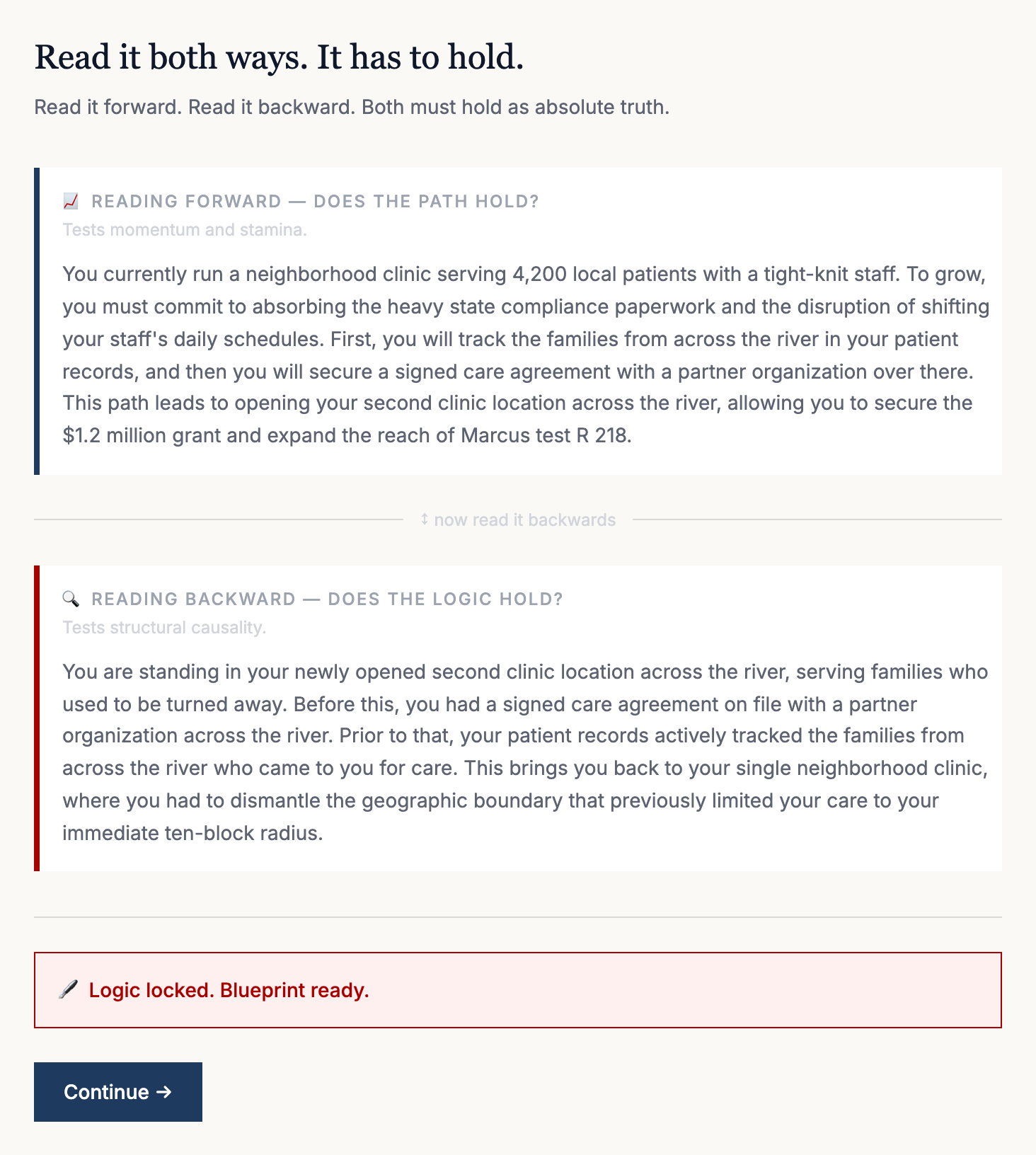
You read the decision forward, from today to the finish line, and backward, from the finish line to today. Forward tests momentum and stamina; backward tests whether each step truly causes the next. Both readings must hold.
The Blueprint
The app draws your decision as three documents, which you download to your device: one to share, with what you decided, what it rests on and who is involved; one private, with the full story of how you got there; and a master copy of everything you built.
The Workshop
From your architecture, the app assembles the documents you need to communicate the decision, such as a decision record or a brief for one person. Each says what your architecture fills and what it will ask you for; gaps are named, never filled.
The app is not open yet. Its beta is coming; see the home page.